Navigo CRM
Case study · 2026Auto-transport brokers ran each shipment across six tools. We built one system where a lead becomes a quote, an order and a dispatched load without anyone retyping it.
Overview
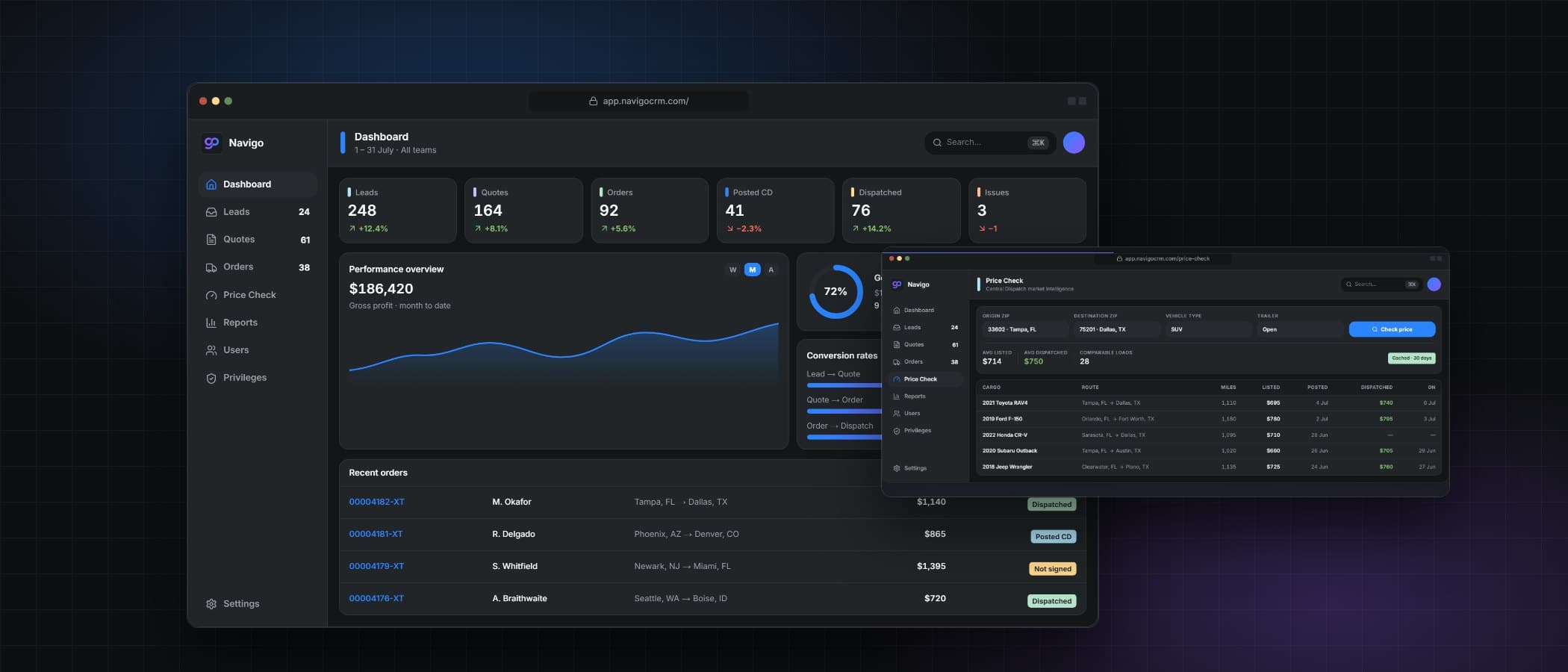
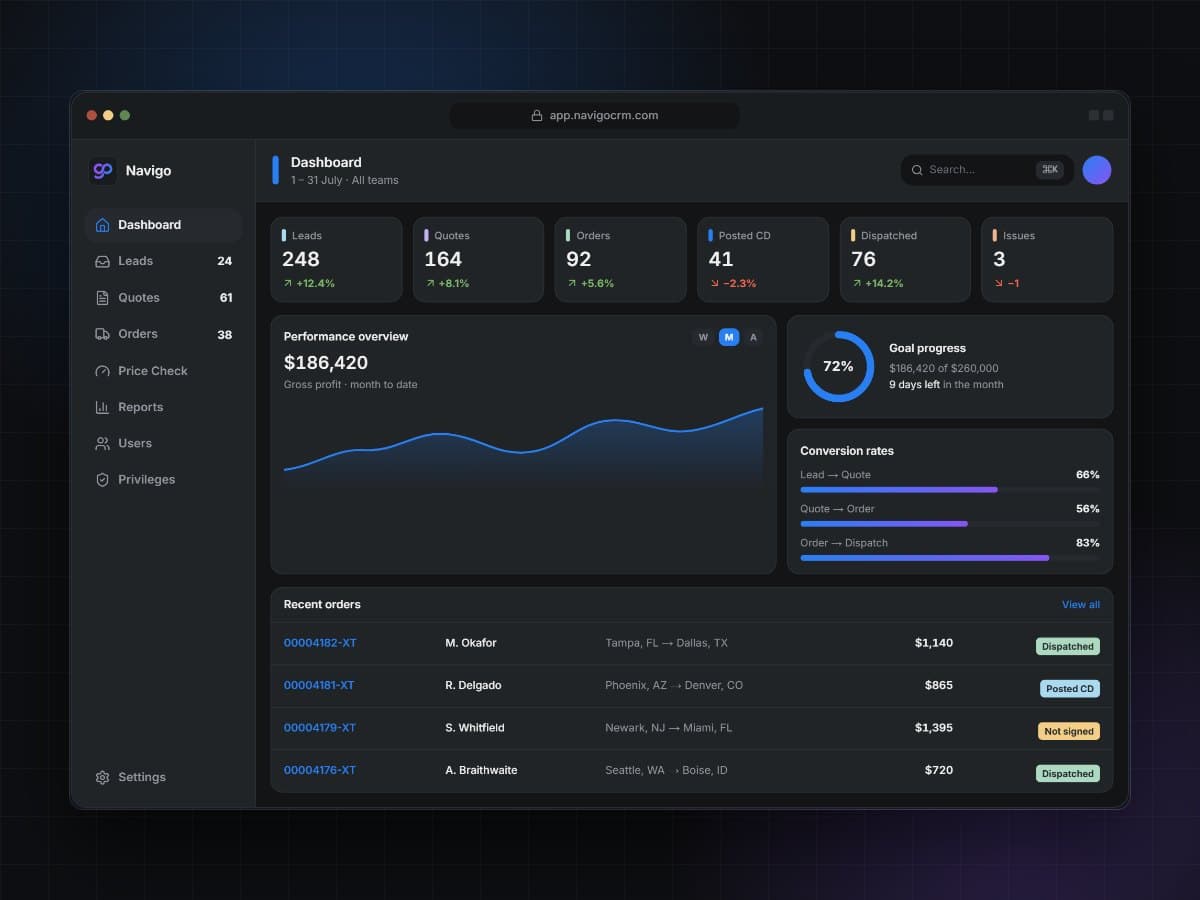
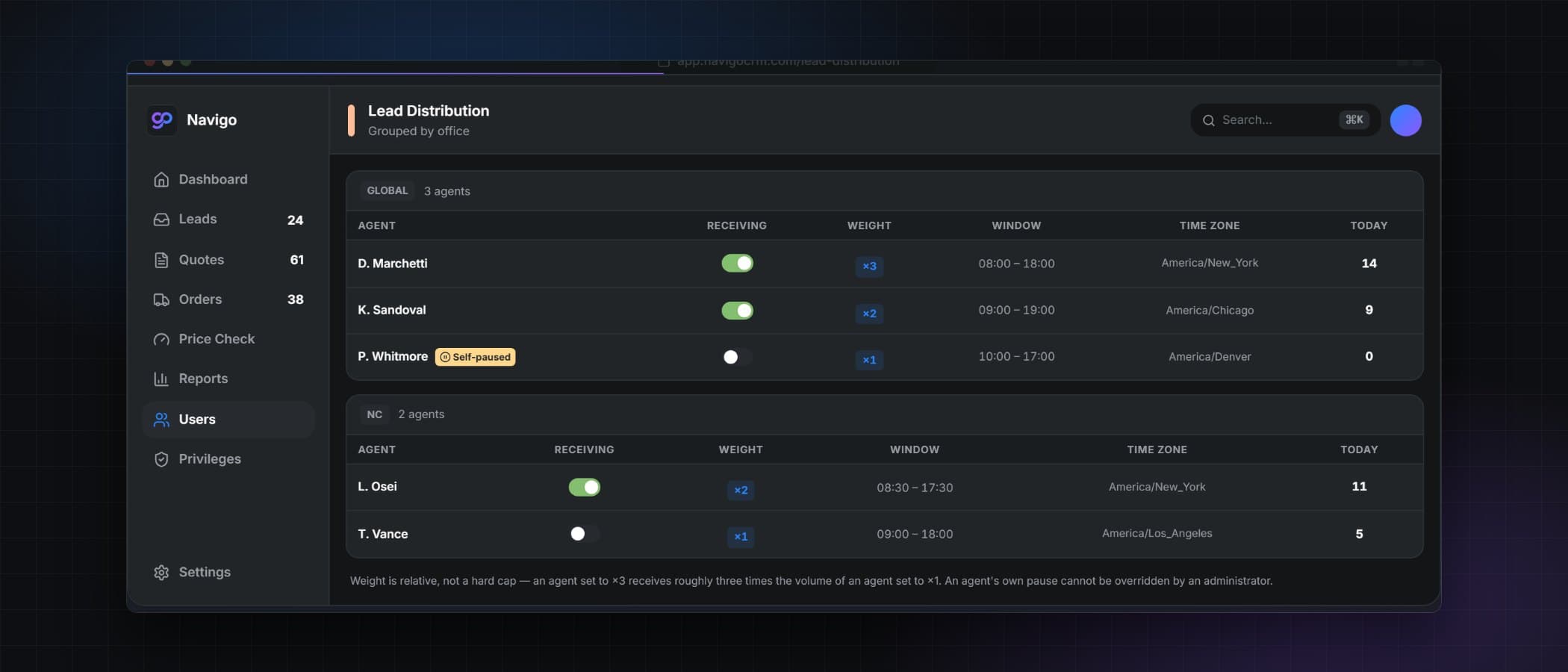
Navigo CRM is a SaaS product for US auto-transport brokers — the companies that arrange car shipping between customers and carriers. Agents take leads from many sources, quote against real market prices, send contracts that customers sign in the browser, take card payments, post loads to Central Dispatch and Super Dispatch, dispatch a carrier and see profit before the month closes. We designed and built the product end to end: the Django backend, the Vue web app, the public lead API and its documentation, the marketing site and the infrastructure it runs on.
The challenge
A broker’s day was split across spreadsheets, the Central Dispatch website, a phone system, a separate e-signature tool and month-end profit sheets. Every handoff meant retyping the same shipment, and nobody could see margin until the month was over. The product had to replace all of it without asking brokers to change how they sell.
- C1
Competitors on one platform
Every brokerage is a separate company, often competing with the others. A leak of one company’s leads or carriers to another is unacceptable.
- C2
Many outside systems
Central Dispatch, Super Dispatch, RingCentral, Zoom Phone, Gmail and QuickBooks each have their own API, limits and failure modes, and their statuses must stay in sync with the order.
- C3
Payments and compliance
Card payments had to pass Intuit’s app review, so card data could never touch our servers.
Our approach — decision logDecision log
One record from first enquiry to archived order — every screen, integration and report reads from it. Below: the decisions that shaped the system, and what each one cost.The decisions that shaped the system, and what each one cost.
| No. | Decision | Why | Trade-off accepted |
|---|---|---|---|
| D1 | A separate database schema for every company, and a separate signing key for its tokens. | Isolation is enforced by the database, not by remembering a filter in every query. A token issued for one brokerage is useless in another. | Creating a company runs schema migrations, and every migration runs once per tenant. |
| D2 | Leads, quotes and orders are one table with a stage, not three. | Converting a quote into an order changes its state instead of copying it, so the history, notes and files follow the shipment. | Each stage keeps its own status field, which makes filtering and validation more involved. |
| D3 | Cards are tokenised in the customer’s browser; market prices are cached for 30 days. | Card numbers never reach our servers, which kept the Intuit review simple. Paid, rate-limited pricing lookups stay instant for repeat routes. | Prices for a route can be up to a month old; agents see the cache date next to every lookup. |
- D1
A separate database schema for every company, and a separate signing key for its tokens.
- Why
- Isolation is enforced by the database, not by remembering a filter in every query. A token issued for one brokerage is useless in another.
- Trade-off
- Creating a company runs schema migrations, and every migration runs once per tenant.
- D2
Leads, quotes and orders are one table with a stage, not three.
- Why
- Converting a quote into an order changes its state instead of copying it, so the history, notes and files follow the shipment.
- Trade-off
- Each stage keeps its own status field, which makes filtering and validation more involved.
- D3
Cards are tokenised in the customer’s browser; market prices are cached for 30 days.
- Why
- Card numbers never reach our servers, which kept the Intuit review simple. Paid, rate-limited pricing lookups stay instant for repeat routes.
- Trade-off
- Prices for a route can be up to a month old; agents see the cache date next to every lookup.
Solution and architectureArchitecture
A Django core, one schema per brokerage, and integrations behind background workers.
The Vue web app talks to a Django REST API; real-time updates — the inbox, notifications and long-running jobs — travel over WebSockets. Celery workers handle everything slow or external: marketplace sync, SMS and email sync, pricing lookups and per-company scheduled tasks. PostgreSQL holds one schema per company; Redis serves as the cache, the queue and the WebSocket layer.
- Built by SwiftCore
- Existing or third-party system
- Single entry point for all clients
Technology
The tools in production on this project, and the reason each was chosen over the alternatives.
Frontend
- Vue 3
- TypeScript
- Vite
- Pinia
- TanStack Query
- Element Plus
- Tailwind CSS
Vue 3 · TypeScript · Vite · Pinia · TanStack Query · Element Plus · Tailwind CSS
A dense, table-heavy back-office app with feature-sliced modules that stay independent as the product grows.
Backend
- Python
- Django
- Django REST Framework
- Celery
- Django Channels
- django-tenants
Python · Django · Django REST Framework · Celery · Django Channels · django-tenants
Mature tooling for a data-heavy business system, with background jobs and WebSockets in the same codebase.
Data
- PostgreSQL
- Redis
PostgreSQL · Redis
Schema-per-tenant isolation in PostgreSQL; Redis for cache, queues and real-time messages.
Infrastructure
- Docker
- Traefik
- Nginx
- GitHub Actions
- Vercel
Docker · Traefik · Nginx · GitHub Actions · Vercel
Containerised services behind a reverse proxy; the web app and the site ship from Vercel.
Quality and tooling
- pytest
- Vitest
- CI on every change
pytest · Vitest · CI on every change
Tests run on every change, against the same PostgreSQL and Redis versions as production.
Inside the product
Results
Outcomes are still being measured.
We publish numbers only after they’ve been measured over a full period and approved by the client. Until then, here is what changed:
- A shipment moves from lead to dispatched load in one record, without being retyped between tools.
- Customers sign contracts and pay by card in the browser, from a link sent by email or SMS.
- Loads are posted to Central Dispatch and carriers dispatched without leaving the order.
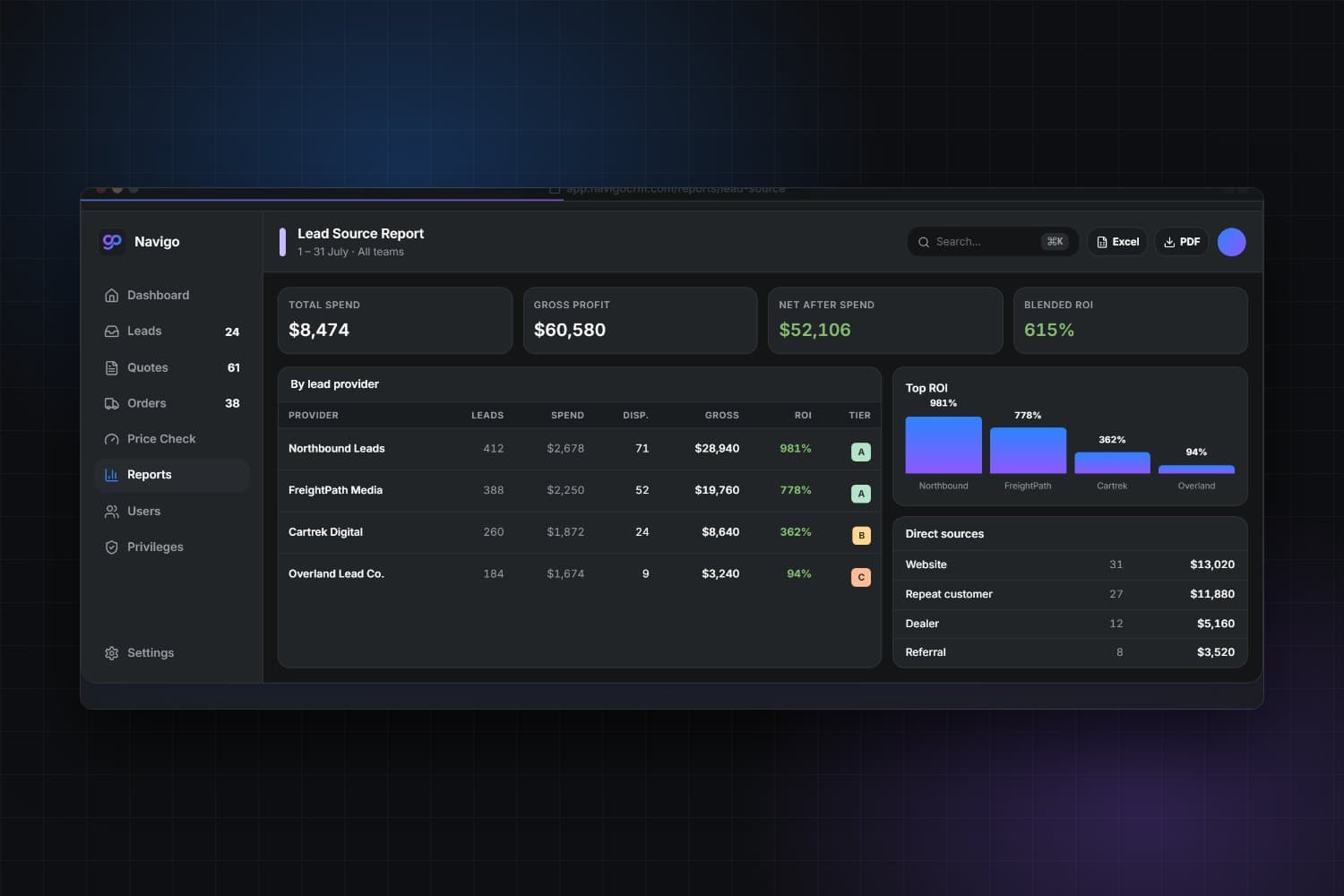
- Gross profit and lead-source ROI are visible mid-month instead of after it closes.